
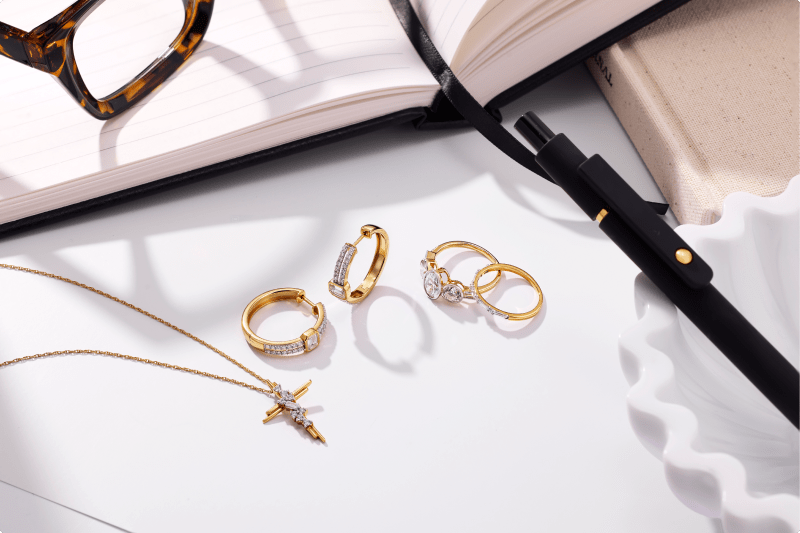
Lab-grown diamonds have become a genuine option alongside natural ones, and the conversation around them has grown significantly. Both are real, both are beautiful, and the difference comes down to origin, value, and what matters most to you.
Are Lab-Grown Diamonds Real?
Yes, completely. Lab-grown diamonds have the same chemical composition, crystal structure, hardness (10 on the Mohs scale), and optical properties as natural diamonds. They're not cubic zirconia or moissanite. The Federal Trade Commission officially recognized lab-grown diamonds as real diamonds in 2018, and both the GIA and IGI certify them using gemological standards.
How Diamonds Are Made
Natural diamonds form 90–150 miles below Earth's surface over millions to billions of years. Carbon atoms crystallize under extreme heat and pressure in the earth's mantle, then volcanic eruptions carry them to the surface through kimberlite pipes where they're mined. Every natural diamond is a piece of ancient geology — shaped entirely by nature over an almost incomprehensible amount of time.
Lab-grown diamonds start as tiny diamond seeds and are created using one of two methods. HPHT (High Pressure High Temperature) subjects carbon to extreme heat and pressure until it crystallizes around the seed, replicating the same conditions that form diamonds in the earth. CVD (Chemical Vapor Deposition) fills a chamber with carbon-rich gas that breaks down and deposits carbon atoms layer by layer onto the seed. Both methods produce diamonds that are chemically identical to natural ones, just on a timeline of weeks rather than billions of years.
How Natural and Lab-Grown Diamonds Compare
Appearance. To the naked eye, lab-grown and natural diamonds are completely the same. Even trained gemologists need specialized equipment to tell them apart. Both are graded on the same 4Cs, cut, color, clarity, and carat.
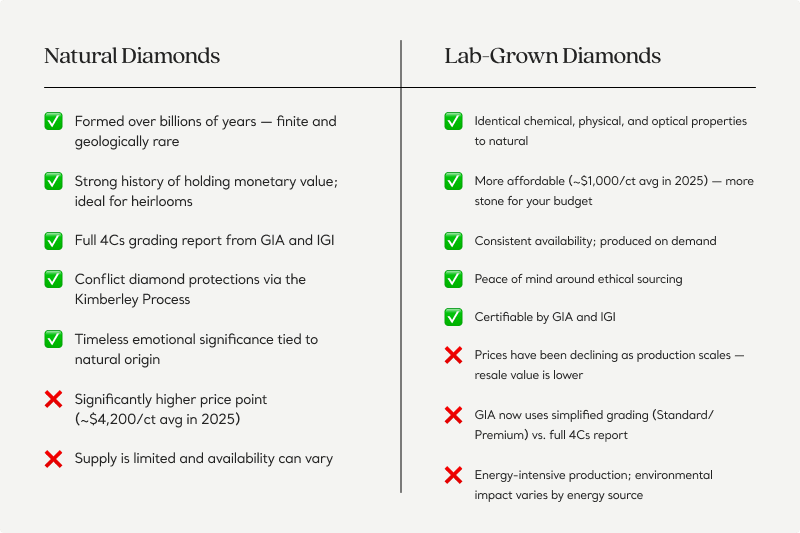
Price. Lab-grown diamonds are significantly more affordable than natural diamonds. In 2025, a 1-carat lab-grown diamond averages around $1,000, while a comparable natural diamond averages around $4,200. That difference gives you real flexibility, a larger stone, a higher clarity grade, or more budget for the setting.
Rarity. Natural diamonds are finite, formed over billions of years, and unique in a way that can't be replicated. Lab-grown diamonds can be produced on demand, which is part of what makes them more accessible and consistent in availability. Because of this, lab-grown diamond prices have continued to decrease as production scales up, while natural diamonds maintain their value through geological scarcity.
Value over time. Natural diamonds have a well-established history of holding monetary value and are frequently passed down through generations. Lab-grown diamonds are an excellent choice for jewelry you want to wear and enjoy, and while resale value differs between the two, an heirloom is defined by meaning, not market price. Both are equally capable of carrying that.
Sourcing. For some buyers, lab-grown diamonds offer peace of mind around ethical sourcing. The natural diamond industry has also made significant strides through programs like the Kimberley Process, which works to eliminate conflict diamonds from the supply chain. It's worth noting that lab-grown diamond production is energy-intensive and its environmental footprint varies depending on the energy source used, so neither option is entirely without impact.
Certification. Both types can be certified by the GIA and IGI. In 2025, the GIA updated its grading approach for lab-grown diamonds, rather than the traditional detailed 4Cs report, lab-grown diamonds now receive a simplified "Standard" or "Premium" classification, reflecting that over 95% of lab-grown diamonds fall within a narrow band of high color and clarity. Natural diamonds continue to receive the full grading report.
Emotional significance. Some people are drawn to the idea of a stone shaped by billions of years of earth's history, the rarity and permanence of that carries real weight. Others find just as much meaning in a stone chosen for its beauty and craftsmanship, regardless of origin. Neither is more valid than the other.
Which Diamond is Right for You?
It comes down to what you value. If rarity, geological history, and long-term value appeal to you, a natural diamond carries all of that. If flexibility, size, and accessibility within your budget matter more, lab-grown is a compelling choice. Both are real diamonds, both are beautiful, and both can mark the moments that matter most.
Jedora's Take
At Jedora, we carry both, because the right diamond is the one that feels right to you. Whether you're drawn to the story behind a natural stone or the craftsmanship of a lab-grown one, we want you to feel confident in what you choose.
The best diamond isn't one type over the other. It's the one you'll love wearing.